
Theories are explanations of a natural or social behaviour, event, or phenomenon. More formally, a scientific theory is a system of constructs (concepts) and propositions (relationships between those constructs) that collectively presents a logical, systematic, and coherent explanation of a phenomenon of interest within some assumptions and boundary conditions (Bacharach 1989).
Agency theory. Agency theory (also called principal-agent theory), a classic theory in the organisational economics literature, was originally proposed by Ross (1973) to explain two-party relationships—such as those between an employer and its employees, between organisational executives and shareholders, and between buyers and sellers—whose goals are not congruent with each other. The goal of agency theory is to specify optimal contracts and the conditions under which such contracts may help minimise the effect of goal incongruence. The core assumptions of this theory are that human beings are self-interested individuals, boundedly rational, and risk-averse, and the theory can be applied at the individual or organisational level.\
Theory is the ‘glue’ that holds social facts together. Theory helps us to conceptualise and explain why things are the way they are, rather than only focusing on how things are.
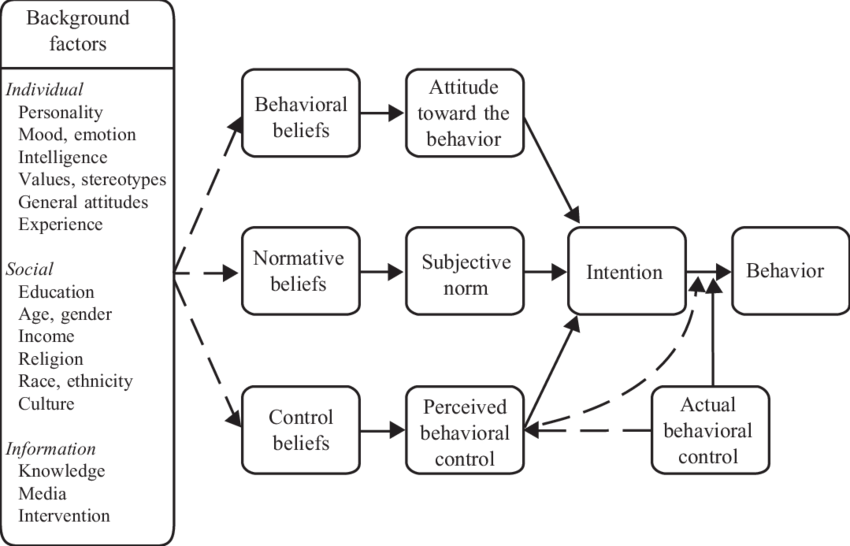
Theory of planned behaviour. Postulated by Azjen (1991), the theory of planned behaviour (TPB) is a generalised theory of human behaviour in social psychology literature that can be used to study a wide range of individual behaviours. It presumes that individual behaviour represents conscious reasoned choice, and is shaped by cognitive thinking and social pressures. The theory postulates that behaviours are based on one’s intention regarding that behaviour, which in turn is a function of the person’s attitude toward the behaviour, subjective norm regarding that behaviour, and perception of control over that behaviour. Attitude is defined as the individual’s overall positive or negative feelings about performing the behaviour in question, which may be assessed as a summation of one’s beliefs regarding the different consequences of that behaviour, weighted by the desirability of those consequences. Subjective norm refers to one’s perception of whether people important to that person expect the person to perform the intended behaviour, and is represented as a weighted combination of the expected norms of different referent groups such as friends, colleagues, or supervisors at work. Behavioural control is one’s perception of internal or external controls constraining the behaviour in question. Internal controls may include the person’s ability to perform the intended behaviour (self-efficacy), while external control refers to the availability of external resources needed to perform that behaviour (facilitating conditions). TPB also suggests that sometimes people may intend to perform a given behaviour but lack the resources needed to do so, and therefore posits that behavioural control can have a direct effect on behaviour, in addition to the indirect effect mediated by intention.
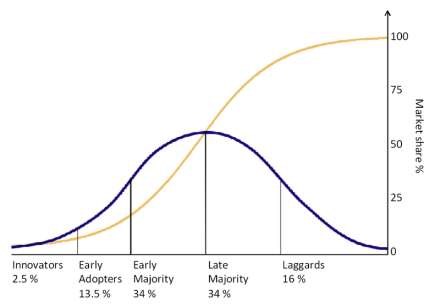
Innovation diffusion theory. Innovation diffusion theory (IDT) is a seminal theory in the communications literature that explains how innovations are adopted within a population of potential adopters. The concept was first studied by French sociologist Gabriel Tarde, but the theory was developed by Everett Rogers in 1962 based on observations of 508 diffusion studies. The four key elements in this theory are: innovation, communication channels, time, and social system. Innovations may include new technologies, new practices, or new ideas, and adopters may be individuals or organisations. At the macro (population) level, IDT views innovation diffusion as a process of communication where people in a social system learn about a new innovation and its potential benefits through communication channels—such as mass media or prior adopters— and are persuaded to adopt it. Diffusion is a temporal process—the diffusion process starts off slow among a few early adopters, then picks up speed as the innovation is adopted by the mainstream population, and finally slows down as the adopter population reaches saturation. The cumulative adoption pattern is therefore an s-shaped curve, as shown in Figure 4.3, and the adopter distribution represents a normal distribution. All adopters are not identical, and adopters can be classified into innovators, early adopters, early majority, late majority, and laggards based on the time of their adoption. The rate of diffusion also depends on characteristics of the social system such as the presence of opinion leaders (experts whose opinions are valued by others) and change agents (people who influence others’ behaviours).