

A corporation is a mechanism established to allow different parties to contribute capital, expertise, and labor for their mutual benefit. The investor/shareholder participates in the profits (in the form of dividends and stock price increases) of the enterprise without taking responsibility for the operations.
McKinsey & Company began surveying the board of directors about their understanding of company issues in 2011. Their latest survey results revealed the following statistics about board members who felt they had a complete or a good understanding of the following:
- Financial Position – 91%
- Current Strategy – 87%
- Value Creation – 74%
- Industry Dynamics – 77%
- Risks the company faces – 69%
Role of the Board in Strategic Management
Laws and standards defining the responsibilities of boards of directors vary from country to country. How does a board of directors fulfill their many responsibilities? The role of the board of directors in strategic management is to carry out three basic tasks:
- Monitor: By acting through its committees, a board can keep abreast of developments inside and outside the corporation, bringing to management’s attention developments it might have overlooked. A board should, at the minimum, carry out this task,
- Evaluate and influence: A board can examine management’s proposals, decisions, and actions; agree or disagree with them; give advice and offer suggestions; and outline alternatives. More active boards perform this task in addition to monitoring,
- Initiate and determine: A board can delineate a corporation’s mission and specify strategic options to its management. Only the most active boards take on this task in addition to the two previous ones.
An article by Spencer Stuart written by an international team of contributors suggested the following five board of director responsibilities:
- Effective board leadership including the processes, makeup, and output of the board
- Strategy of the organization
- Risk vs. initiative and the overall risk profile of the organization
- Succession planning for the board and top management team
- Sustainability
Boards in the United Kingdom typically have 5 inside and 5 outside directors, whereas in France boards usually consist of 3 insiders and 8 outsiders. Japanese boards, in contrast, contain 2 outsiders and 12 insiders. The board of directors in a typical small USA corporation has 4 to 5 members, of whom only 1 or 2 are outsiders. Research from large and small corporations reveals a negative relationship between board size and firm profitability.
People who favor a high proportion of outsiders state that outside directors are less biased and more likely to evaluate management’s performance objectively than are inside directors. This is the main reason why the U.S. Securities and Exchange Commission (SEC) in 2003 required that a majority of directors on the board be independent outsiders.
Agency Theory.
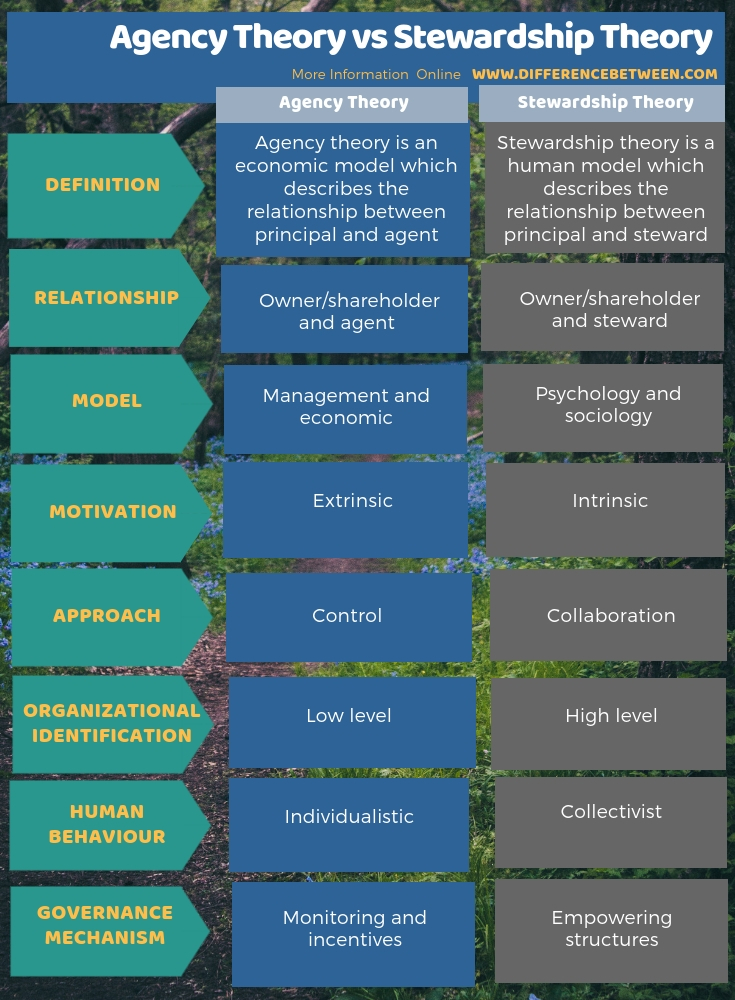
Agency theory is a concept used to explain the important relationships between principals and their relative agent. In the most basic sense, the principal is someone who heavily relies on an agent to execute specific financial decisions and transactions that can result in fluctuating outcomes.
A s suggested in the classic study by Berle and Means, top managers are, in effect, “hired hands” who are very likely more interested in their personal welfare than that of the shareholders. For example, management might emphasize strategies, such as acquisitions, that increase the size of the firm (to become more powerful and to demand increased pay and benefits) or that diversify the firm into unrelated businesses (to reduce short-term risk and to allow them to put less effort into a core product line that may be facing difficulty) but that result in a reduction of dividends and/or stock price.
Agency theory is concerned with analyzing and resolving two problems that occur in relationships between principals (owners/shareholders) and their agents (top management):
- Conflict of interest arises when the desires or objectives of the owners and the agents conflict. For example, attitudes toward risk may be quite different.
Agents may shy away from riskier strategies in order to protect their jobs. - Moral hazard refers to the situation where it is difficult or expensive for the owners to verify what the agents are actually doing.
Stewardship Theory.
In contrast, stewardship theory suggests that executives tend to be more motivated to act self-interests. Whereas agency theory focuses on extrinsic rewards that serve lower-level needs, such as pay and security, stewardship theory focuses on the higher-order needs, such as achievement and self-actualization. Stewardship theory argues that senior executives over time tend to view the corporation as an extension of themselves.
What is the Difference Between Agency Theory and Stewardship Theory?
UUM BOD : How many BOD members for UUM <<<click here>>>
Uniutama Management Holdings Sdn Bhd <<<click here>>>
PETRONAS BOD <<<click here>>>